|
My Soul Looks Back in Wonder
April 2004
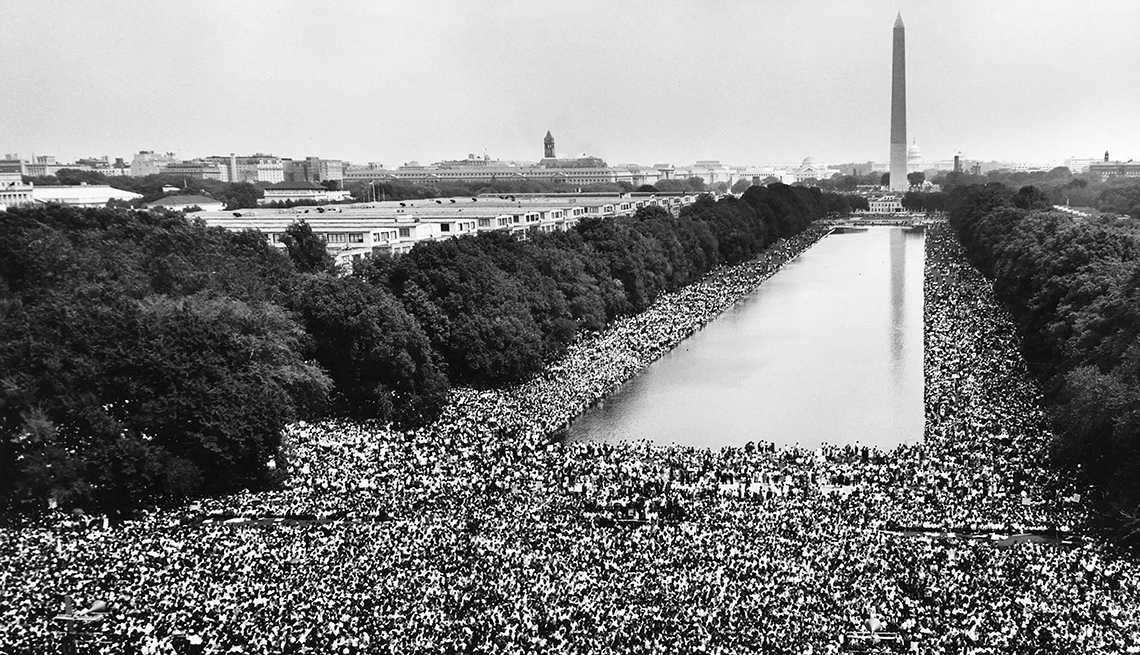
A new book from the Voices of Civil Rights project will transform the way you think about freedom—and how it was won
|
The historic struggle for civil rights revolutionized every aspect of
American life. Today that battle continues to shape what it means to be free in
a modern society. In My Soul Looks Back in Wonder: Voices of the Civil
Rights Experience (Sterling Publishing Co., Inc., May 2004), bestselling
author and Emmy-winning NPR correspondent Juan Williams presents the harrowing
and inspiring stories of men and women forever changed by their experiences on
the front lines of freedom.
Timed to coincide with the 50th anniversary of the
U.S. Supreme Court's Brown v. Board of Education decision on May 17,
this book will radically transform the way you think about freedom—and
how it was won.
"This is not just a black-and-white story," writes Williams.
"It embraces all of us. It is the story of the human spirit rising to
embrace a vision of a world in which men and women of all races are free to be
themselves. Technology and economics may appear to trigger societal
change, but most often the shift begins with an individual; he or she touches
someone who then takes an action that, no matter how slight it seems, builds
inexorably into a grand movement of people."
The book is part of AARP and the Leadership Conference on Civil Rights' extensive Voices of Civil Rights project. My Soul
Looks Back in Wonder reaches back more than 50 years to retrace the roots
of the Civil Rights Movement. B. B. King—among the nearly 50 civil rights
veterans profiled in these pages—discusses his constant fight for
acceptance to do what he loved: "Many times I've felt like I was being
black twice. I got put down by white people because of my color and by my own
people because I'm a blues singer." Carol Swann-Daniels—one of
two students chosen to integrate a middle school in Richmond—recounts
what it was like going to a school every day where she was not accepted.
"Gym was particularly horrible because we had to do sit-ups. The other
students saw us as contaminated; no one wanted to hold down our feet or have
any kind of physical contact."
Other poignant stories abound. Carolyn McKinstry was one of the children at
the 16th Street Baptist Church in Birmingham on the September 1963 day it was
bombed by the Klan and four black girls were killed. Raylawni Branch broke the
color barrier at three institutions in her hometown of Hattiesburg,
Mississippi. Dr. Alvin F. Poussaint remembers the pivotal aftermath of a
brutally suppressed march in Canton, Mississippi, where in 1966 the local
police tear-gassed and clubbed women and children: " 'They're
killing my people,' Stokely Carmichael said. In a rage he raised his fist
and said, 'Black Power! Black Power! Black Power!' It went out all
across the country. It was a dramatic moment, a moment that changed
America."
Initial victories in the struggle for civil rights emboldened and inspired
other disenfranchised groups to demand their rights as citizens too. For
wheelchair user Michele Steger, the battle took the form of street
demonstrations to win access to restaurants and city buses. Feminist activist
Diane Brownmiller adapted the sit-in tactics she learned during
Mississippi's Freedom Summer, 1964, to publicize what she saw as the
"conscious process of intimidation" by which a sexist culture kept
women in line. And Native American Suzan Shown Harjo dates the dawn of her
political consciousness to the morning her second-grade teacher threw her out a
second-story window for challenging his account of the Battle of the Little Big
Horn.
From recollections of 50 years ago to present-day struggles to advance
the civil rights of Hispanics, immigrants, gays and lesbians, and people with
disabilities, My Soul Looks Back in Wonder spells out how ripples of personal
change can trigger tidal waves of social transformation.
All in the Family
(An excerpt from the introduction to My Soul Looks Back in
Wonder)
By Juan Williams
My grandfather died while building the Panama Canal. As he stood in that
tropical heat and mud taking his last breath, his imagination could extend only
so far. What might he have envisioned for his son?
My father, standing on a street corner in Jamaica (where he was born in
1902), could never have imagined himself leaving his home and moving to the
United States, where he and his children would find opportunities beyond his
most fanciful dreams. Nor could he have ever imagined me, standing on a street
corner today in Washington, D.C., as an author, reporter, and radio and TV
newscaster with a job that allows me to help shape public opinion and go head
to head with some of the nation's most powerful leaders.
And what about the fourth generation—my children? Already I see them
probing the boundaries of possibility as they pursue directions in their lives
inconceivable to me as a child in Brooklyn.
All of this is magic—yet what sorcerer could conjure such amazing
transformations? Call it the everyday magic of the family: Each of us begins
the journey toward personal discovery because someone else gave us a vision
that allows us to be more creative, more resourceful, more powerful than the
child inside us ever thought possible.
The pattern of one person awakening, sharing, and organizing is key to
positive social change. It is the story of the American Revolution, the battle
to abolish slavery, the fight to secure for women the right to vote. Technology
and economics may appear to trigger societal change, but most often the
shift begins with an individual; he or she touches someone who then takes an
action that, no matter how slight it seems, builds inexorably into a grand
movement of people.
Buy this
intimate view of history in the making to discover for yourself just how
much the battle for civil rights has profoundly touched the lives of all
Americans.
|