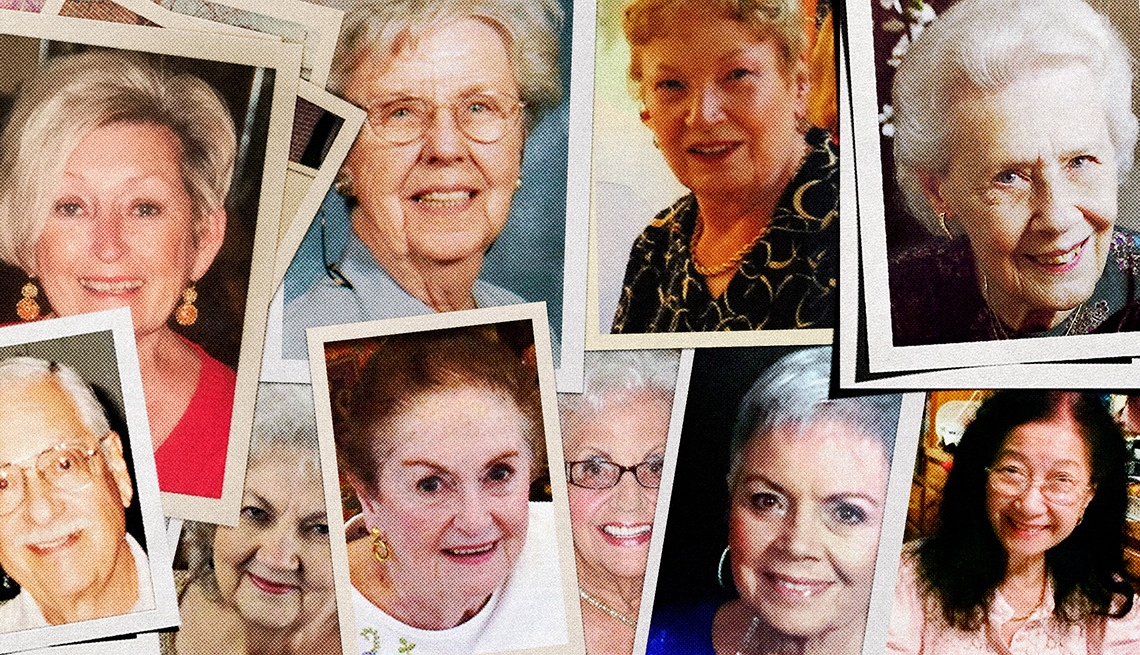
Photography by John Blais
|
Hitting It Big
By Julie Connelly, November & December 2005
It's easy to assume that wildly successful people—those who have riches, power, or fame—were charmed at birth. But many become superstars only after age 50, after years of hard work
|
However you define success—reaching your goals, being recognized for
work well done, accumulating wealth—these fabulous five prove that
success is better late than ever.
Just One Book—That's All It Took
Sylvia Nasar, 58, Tarrytown, New York
Sylvia Nasar learned about the life of John Nash, the genius mathematician
who would make her famous, in 1993, a year before he won the Nobel Prize in
economics. She was interviewing a source for The New York Times, where she was
an economics reporter, and he mentioned the rumor that the long-forgotten Nash
was a Nobel contender. As a graduate student in economics, she had studied
Nash's equilibrium theory, first published in 1950. Nasar assumed that Nash
was dead, but she soon learned that he was roaming the campus of Princeton
University, a ghostly figure slowly emerging from the paranoid schizophrenia
that had fractured his mind during his youth and destroyed his cometlike
career. "I really felt like this was the most amazing story I'd ever
come across as a reporter," she says.
Nasar wrote an article detailing his precocious youth, his decline into
schizophrenia, and his remarkable journey back to sanity. Her story drew an
enormous response from readers—and lucrative book offers. She hadn't
intended to write a book, but these two factors "made me realize I've
got to do this," she says.
A Beautiful Mind was published in 1998, when Nasar was 51. It wasn't an
overnight success. But when the book was made into a film directed by Ron
Howard—which won an Oscar for best picture in 2002—it became a
bestseller. (And yes, she met Russell Crowe.)
"I didn't write the book because I thought it would get me
somewhere," she says. "I just thought the story was so
compelling." Nonetheless she enjoys her success: "I've met
amazing people. I'd never gone to a book reading or an author lecture
before I gave them. And is that fun? Oh, yeah, that's fun."
Thanks to A Beautiful Mind, Nasar is now Columbia University's first
Knight professor of business journalism and is busy writing her second book,
which is about great economics thinkers of the 20th century. She feels
incredibly lucky: "I have options about what to do with my life at an age
when a lot of people's options are narrowing."
Plays With Dirt, Feeds the World
Pedro A. Sanchez, 65, Upper Grandview, New York
If things had gone as planned, Pedro A. Sanchez would be running his
father's fertilizer company in Havana and much more of the world's
population would be starving. Instead the Cuban Revolution forced his family to
flee in 1960 to the U.S., where Sanchez, the oldest of four children, was
studying agronomy at Cornell University. As the family business was gone,
Sanchez switched to plan B: to become an expert in tropical soils so he could
fight world hunger. A seminar at Cornell had stunned him by revealing the
potential for massive starvation in India. "That threat inspired me to
choose this work," he says. He had no inkling that he'd one day be
honored globally as one of the most prominent people in his field.
In 1968 Sanchez went to Peru and helped the country achieve self-sufficiency
in rice in just three years. Later he helped Brazilian scientists use 70
million acres of land in the Cerrado region, long assumed useless, and now
their soybean production equals that of the U.S.
After 50, Sanchez began his work in Africa, where he has helped millions of
farmers boost their crop yields by planting trees that add nitrogen to the
soil. "I love to play with dirt," he says. Asked if he gardens, he
replies: "My garden is a village in western Kenya called Sauri, where they
made me an honorary tribal chief, telling me that the trees had restored the
villagers' dignity because now they could feed their families."
While Sanchez was held in great esteem by grateful farmers and his peer
scientists, he achieved worldwide acclaim only after two recent events.
In 2003 he won the World Food Prize—often compared in importance to
the Nobel Prize—for his lifelong achievements in reducing hunger. A year
later he was awakened from a nap by a telephone call from the MacArthur
Foundation telling him he was receiving one of its "genius grants" of
$500,000.
Now the director of the Tropical Agriculture Program at Columbia
University's Earth Institute, Sanchez understands the changes and
opportunities that have come with his recognition. "I've got notoriety
now," he says. "People take me more seriously, and I can influence
the cause of eliminating world hunger for good."
She Has a Ph.D. in Perseverance Too
Verna J. Willis, 78, Atlanta, Georgia
For most of her life Verna J. Willis has known very little stability.
Divorced in her late 40s, with five of her seven children still at home in
Orchard Park, New York, she had jobs that always turned out to be short-term.
She kept at her studies, however, and eventually earned a Ph.D. in education
from the State University of New York at Buffalo.
By her late 50s Willis was frustrated and wrote a set of goals. At the top:
a tenure-track position at a university. "I knew that was the only way
I'd ever have job security," she says. She had no clue how to get
there.
She took a 13-month teaching job with a World Bank project in Indonesia, and
she began to feel desperate as it was winding down: "I was going home in a
few months and I had nothing to pay the mortgage."
Then a friend told her of an opening at Georgia State University. Willis
flew halfway around the world on her own nickel to interview for the job in
Atlanta. "I think that impressed them," she says. At nearly 62 she
was hired to create a new degree program in human resources development. And
four years later Willis was awarded tenure. In 1991 Willis called for the
creation of a new corporate job: chief learning officer, in charge of expanding
worker skills. Today the position exists in hundreds of organizations, such as
Boeing and the U.S. Navy.
Willis retired last year at 77. "I figured that if I didn't, I
wouldn't have any retirement," she jokes. She now teaches her courses
online.
From Struggling Duffer to Golf's Iron Man
Dana Quigley, 58, West Palm Beach, Florida
Golf is Dana Quigley's obsession. He plays every day unless it's
raining so hard he can't, and he doesn't think it's extraordinary
to polish off 54 holes—three rounds of 18—in a day. When he lost
his exempt status from the PGA Tour in 1983 after five middling years, he took
a $40,000-a-year job as a teaching pro at a country club. "I didn't
have to work very hard to stay there," he says.
Another obsession was undermining his potential: alcohol. He drank heavily,
he says, because he never thought he was good enough as a golfer. Drinking cost
him his first marriage and the custody of his two children and caused two
automobile accidents. Finally one night in 1990, as Quigley was speeding home
from the golf course, "half-gassed again," he recalls, "I
thought: Man, this is crazy." He switched to nonalcoholic beer. Amazingly,
without the help of rehab or Alcoholics Anonymous, he hasn't had a drink
since.
As he neared 50 Quigley started thinking about joining the Champions Tour,
which is the PGA Tour's circuit for players 50 and over. But he still
suffered from the paralyzing lack of confidence that had sabotaged him years
before. "My game was always good enough," he says, "but I had no
self-esteem." If players like Jack Nicklaus or Tom Watson came near him on
a practice tee, he'd slink away.
At the urging of his brother, Paul, and his friend professional golfer Brad
Faxon, Quigley spent three days in November 1996 with sports psychologist Bob
Rotella. "We'd get up in the morning and talk," he says. Rotella
convinced Quigley that he had a winner's game and was a match for anyone.
The pep talks caused a transformation that still leaves Quigley astonished.
"I have no idea how Bob did it," he says. Quigley went on to win the
next five events he entered. In 1997 he joined the Champions Tour and has
played in 264 consecutive events since—a record that has earned him the
nickname Iron Man. In last May's tour he surpassed $11 million in career
winnings—more than Jack Nicklaus's career tally. While he no longer
lacks confidence, Quigley is still adjusting to fame. "I spent 50 years in
obscurity," he says buoyantly, "and now people who don't even
know me, know me."
She Proved Her Mettle With Steel
Barbara Manzi, 61, Brooksville, Florida
Barbara Manzi's life acquired purpose when her high school sewing
teacher told her: "Barbara, you'd better learn to cook and sew,
because as a poor black child you're not going to amount to much."
"I didn't even know I was poor until she said that!" says
Manzi, who grew up in Cape Cod, Massachusetts, the third of 12 children.
"But her comment made me realize that I was going to be a hard worker and
I was not going to cook and sew all my life."
After she graduated from high school, Manzi married a New York City police
officer and had two children. She began working in retail, and her sales
experience eventually landed her a job with a local metals distributor that
offered on-the-job training. She leapt at the chance to sit between the
company's two top sellers so she could study their skills.
In working with clients Manzi discovered that the federal government
reserved about 20 percent of its contract awards for women- and minority-owned
suppliers. After she gained experience with federal contracts, she started
thinking about leaving to open her own metals-distribution business. An
executive scoffed at the idea, saying that she would need too much start-up
cash and implying that as a black woman she'd never get it. "I
thought, Oh yeah? I can do this just as well as you can," says Manzi. She
resigned.
Refinancing her two cars for seed money, she opened Manzi Metals, Inc., in
Brooksville, Florida, in 1995. At age 51 her total revenues that first year
were $145,000. Today she has 14 employees and, thanks to customers such as
Lockheed Martin and Rolls-Royce, her revenues in 2004 were more than $5
million. Manzi's goal? To grow enough to omit the words small business from
her credentials. "I want to become the Oprah of raw materials," she
declares.
|