January 7, 2009


Advertisement


Photo by Richard Corman

Sore No More

By Kelly Griffin, November & December 2006

Simple mental and physical tactics can keep arthritis from slowing you down. Show pain who's boss with this step-by-step guide to relief


Tricia Kissel lives an active life. The Los Gatos, California, educator works out three days a week, does tai chi most mornings, travels frequently, and is a busy volunteer. To meet her, you'd never suspect the 79-year-old has had arthritis since she was in her 40s.

What's her secret? Two decades ago Kissel signed up for a fledgling arthritis self-management program at Stanford University. It helped her so much that she became a peer leader, teaching other people with arthritis to take better care of themselves and their aching joints.

There are more than 100 different types of arthritis, but the kind that Kissel has, osteoarthritis, is by far the most common. Almost 21 million Americans have OA, which occurs when cartilage—the hard, slippery surface that coats the joints—breaks down. The wearing away of the body's built-in shock absorber causes changes in the underlying bone and in the tissues surrounding the joint. And that, in turn, further damages the cartilage.

While arthritis is almost a certainty if you live long enough, pain and disability are not. In fact, only one third of people whose x-rays show signs of arthritis actually feel its effects. And only a minority of them eventually need joint-replacement surgery.

"Most people can and should be able to take care of arthritis on their own," says rheumatologist Kenneth Brandt, M.D., professor emeritus of medicine and orthopedic surgery at Indiana University School of Medicine.

The key to gaining control of your arthritis is to do what Kissel did: become an expert patient. "A person coping with arthritis makes 99 percent of their decisions outside of the doctor's office," says Stanford professor Kate Lorig, R.N., Dr.P.H., who created the program that helped Kissel. "An expert patient is a patient who has the knowledge and skills to make good decisions about their care."

The easiest way to sharpen your self-management skills is to enroll in a program such as the Arthritis Foundation Self-Help Program (see Resources box), in which participants learn about exercise, nutrition, pain management, and medication use primarily by doing—setting goals, creating weekly action plans, solving problems, and giving and getting feedback.

Such programs have been shown to reduce arthritis pain by 20 percent and physician visits by 40 percent—benefits that persist for years. In addition, says Lorig, "people who go through these programs become less worried about their health." Yet fewer than one percent of patients with doctor-diagnosed arthritis participate in such programs. Psychologist Francis Keefe, Ph.D., who teaches self-management at Duke University Medical Center, in Durham, North Carolina, likens becoming an expert patient to learning to become a master chef. "Most arthritis patients come into the clinic much like an unseasoned cook," he says. "Their menu of skills is pretty short: resting and taking medication."

To expand your menu, Keefe recommends starting with a few easy-to-learn skills that provide fairly quick results. Mastering these fundamentals of self-care will build confidence, which is an essential ingredient when you're dealing with a chronic condition such as arthritis.


Psych Out Pain
While the physical source of your pain might be a rough-looking area in your knee or hip joint, your experience of pain happens at least partially within the larger real estate of your brain. That means you can use your head to lessen your symptoms. Here are some strategies for doing so.

Breathing lessons Learning to relax through deep breathing can take your mind off joint pain—and thereby ease it. Abdominal breathing (also called diaphragmatic, or belly, breathing) is the most basic relaxation exercise you can do.

To learn this skill, lie on your back or sit comfortably. Place one hand on your abdomen, just above your navel, and the other on your upper chest. Breathe in slowly through your nose and try to feel your abdomen rising. Your upper chest shouldn't move much at all. When you have inhaled fully, breathe out slowly through your lips and imagine a balloon deflating.

Continue breathing this way for five minutes, and try to practice daily. You can use this skill whenever you want to relax.

Getting loose Muscle tightness is a common side effect of arthritis pain. Releasing the tension in your muscles at least once a day can ease this tightness. To learn this technique, lie down with your legs uncrossed, and rest your arms at your sides. Take a few slow abdominal breaths, and with each exhale, imagine your body sinking more deeply into the surface you're lying on as the tension drains out of your muscles.

Step two of this exercise is to alternately tense and release your muscles, one muscle group at a time. Begin by tensing and then relaxing the muscles in your feet and calves. Then continue moving upward to your knees, thighs, and buttocks; your abdomen and chest; your hands and arms; your upper back, shoulders, and neck; and finally your face and head.

When you are done, simply remain still and rest for a few minutes. Mentally scan your body and notice if there is a residue of tension anywhere. Let it go.

Body survey Once you are able to will your muscles to relax, you can simply focus your attention on each muscle group and relax it in turn. Start with your feet and calves. Breathe abdominally as you do this exercise, pausing at each muscle group to scan for tension. If you notice some tightness, try to release it during your next exhalation. Then move on to the next muscle group.

Keefe advises taking 10 to 20 minibreaks throughout the day, scanning your body for signs of tension and then letting go. Traffic jams and checkout lines are great opportunities to do this. It's also helpful to take a minibreak just before doing an activity that causes pain, such as climbing stairs.

Mind over matter Deliberately distracting yourself is a useful way to get through brief but painful activities, says Lorig. If you find stair climbing difficult, try counting backward from 100 by threes as you go up the steps. Or mentally go through the alphabet, one letter per step, thinking of a boy's or a girl's name that begins with that letter.

Sweet daydreams Like mental distraction, guided imagery is a technique for consciously refocusing attention away from pain and toward something else—in this case, a physical setting that gives you a sense of peace or happiness. That setting could be the beach or the forest, a garden or a waterfall.

Close your eyes and take three minutes to bring the setting to life visually. Then put yourself in the picture and walk through the landscape you've created in your mind's eye. If you are imagining yourself at the beach, don't just see the sky and the sand and the sea. Listen to the cry of the seagulls and the laughter of children. Smell the salty ocean spray. Feel the warmth of the sun and the grittiness of the sand.

"People absolutely love this exercise," says Keefe. "In just three minutes they can get a respite from their pain."

Positive charge Ruminating over your aching joints won't make the pain go away, and it can make you feel helpless, anxious, or downright depressed. In fact, negative self-talk—what psychologists call catastrophic thinking—is one of the best predictors of declining function in arthritis.

Listen for any self-defeating statement that repeats itself in your mind. Telltale phrases include I can't… and If only I could…. When you notice yourself making a negative self-statement, write it down on an index card. Then flip the card over and write down an honest, accurate comeback—a positive self-statement that reflects your capabilities.

"It may sound silly," says Keefe, "but the patients who use this say it really works."


Resources

Arthritis Foundation
Offers information about and resources for arthritis, such as books, exercise DVDs, free brochures, and a wide range of programs, including the Arthritis Foundation Self-Help Program, Exercise Program, and Aquatic Program. For a free brochure on osteoarthritis or to learn more, call 800-568-4045.

National Institute of Arthritis and Musculoskeletal and Skin Diseases (NIAMS)
The primary National Institutes of Health (NIH) organization for research and information about osteoarthritis. NIAMS publications are free and can be ordered by calling 877-226-4267 or visiting the website.

Centers for Disease Control and Prevention (CDC)
Provides information about arthritis, including links to federally funded state arthritis programs. Call 770-488-5464 or visit the website.

Stanford Patient Education Research Center
Features a list of organizations around the country that offer self-management programs for arthritis and other chronic diseases. Call 650-723-7935 to find a program in your state.

The Arthritis Helpbook
by Kate Lorig, R.N., Dr.P.H., and James Fries, M.D. (Da Capo Press, 2006). If you can't attend an Arthritis Foundation Self-Help Program, this book is the next best thing. The companion resource for the Arthritis Foundation course, it covers all the basics of self-management. —K.G.

Get Moving
Once you've built your mental self-care skills, get your body in on the action. According to Lorig, the benefits of exercise are a well-kept secret for too many. "People with arthritis tend to think they're so delicate and that if they exercise, they're going to hurt themselves," she says. "In fact it's pretty hard for them to hurt themselves. The most dangerous exercise that people with arthritis can do is to do no exercise at all."

That's because cartilage, bones, and muscles all require movement to stay healthy. A well-rounded program that includes stretching, strengthening, and aerobic activity is the best way to reduce pain and ward off disability.

"Regular physical activity means you'll have a third less chance of becoming disabled and being totally dependent on somebody," says Patience White, M.D., the Arthritis Foundation's chief public health officer. "That's a huge difference."

The American College of Rheumatology recommends that people with arthritis get at least 30 minutes of moderate physical activity three to five days a week. You don't have to log that half-hour all at once. Three 10-minute bouts of exercise will have the same benefits for your joints. "That's doable for anyone," says White.

If you've been sedentary for a long time or have severe pain, consider seeing a physical therapist before you get started.

A PT can evaluate your strength, mobility, and balance and prescribe a customized program to help you exercise safely.

Stretch your range According to Sue Stovall, D.P.T., director of Southern Pines Physical Therapy in Southern Pines, North Carolina, exercises to improve flexibility are step one. "You need to regain pain-free range of motion before you can start strengthening," she says, "because if you push a joint past its limit with too much force, all you're doing is keeping the cycle of pain and inflammation going."

A well-rounded flexibility program includes stretches for your neck, shoulders, arms, wrists, hands, back, hips, knees, ankles, and feet. You may find it helpful to join an aquatic-exercise class or schedule a session with a physical therapist or a certified yoga instructor who is knowledgeable about the needs of those with arthritis.

You may find it easiest to do range-of-motion exercises after a warm bath or a shower. You can also incorporate stretches into daily activities such as watching TV. To get the circulation-enhancing, flexibility-increasing benefits of stretching, do these exercises every day, the same exercises on both sides of the body.

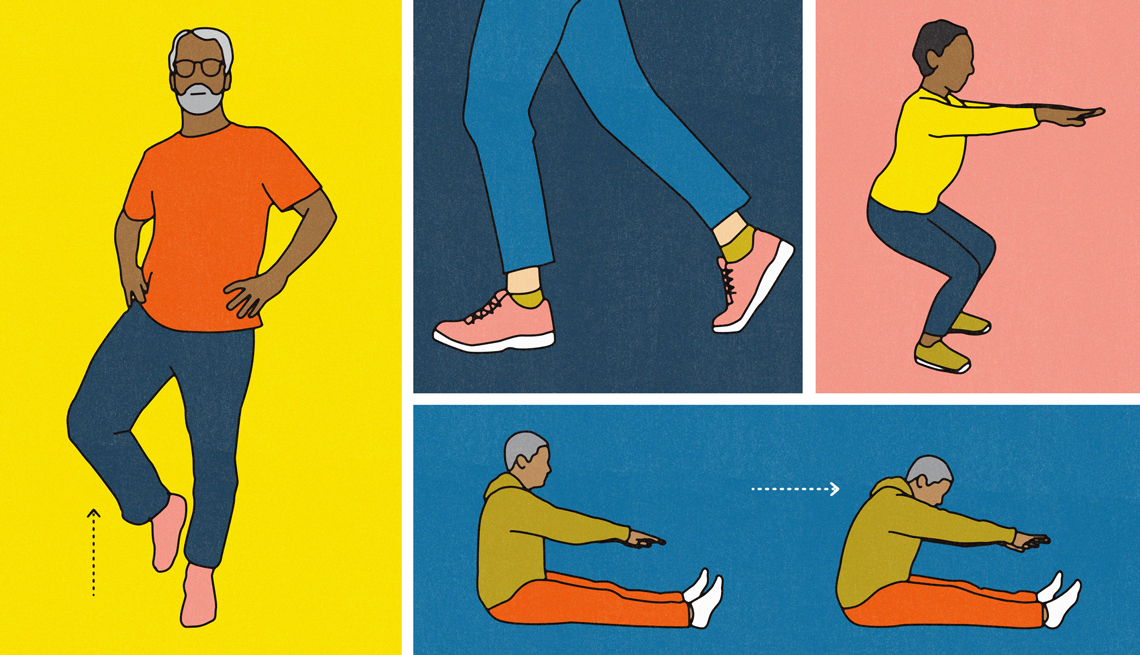
Build muscle "Anybody with knee arthritis who came to see me would get a talk about strengthening the muscles," says rheumatologist Brandt. The muscles that surround the knee help lessen the load on the joints. Weak muscles may mean more pain and damage. If you have knee OA, exercises that strengthen the quadriceps are especially important. These muscles, which run along the front of each thigh, help absorb shock, reducing stress on the knee joint. Squats, lunges, and step exercises are basic moves that will help strengthen these muscles if done correctly. Since they can be harmful to joints if done incorrectly, consult an expert before adding them to your regimen.

Ramp up your heart rate Studies have shown that walking and other aerobic exercises are as effective as strengthening exercises in reducing arthritis pain. They will also improve your mood and energy, help you sleep better, and keep you from becoming a Blanche DuBois—always relying on the kindness of strangers.

Walking is the most convenient form of exercise, and it doesn't require any equipment beyond a comfortable pair of shoes with well-cushioned soles. If you have any new pain after starting your walking program, consult a doctor, a physical therapist, or a podiatrist. When indicated, shoe inserts or prescription orthotics can improve your body mechanics to reduce stress on joints. Bicycling, aerobic dancing, and swimming are other good choices for aerobic activity. Aquatic exercise is ideal for people with arthritis because the water supports the body.

Pace yourself Exercise is important, but it's only half of the activity equation. The other half is rest. Keefe notes that one of the greatest challenges for people with arthritis isn't necessarily that they're doing too little—it's that they're doing too much. "A lot of people with arthritis pain have trouble pacing," he says. Knowing when to take a breather "is a skill, and it's something people with arthritis need to learn to do."

Successful pacing starts with listening to your body. Keep an activity record for at least a week—noting what you did, for how long, and how you felt afterward. Look for patterns in activity and pain. Then put yourself on a strict schedule of activity and rest, starting with a period of activity that is shorter than what you usually attempt. Forget about "No pain, no gain." The goal is not to work to the limits of your pain but to stop before pain starts.

While cutting back on activity may seem like a step backward, if you stick to this plan, you'll find that eventually you can do much more. "Typically, we can get people to double or triple their tolerance," says Keefe.


Know Your Pain Relievers
Being kind to your joints is one way of taking control. But when you can't kill the pain with kindness alone, it's probably time to add more intensive pain-relief therapies to your regimen. Fortunately, there are a lot of options, and not all of them come in a bottle.

Heat and cold Heating pads and ice packs are cheap, readily available options for arthritis pain. A good rule of thumb is to use heat before exercise to relax the muscles and to use ice afterward to reduce pain and swelling.

Many experts, however, say that these before-and-after rules don't necessarily apply to people with OA. "Normally we say that if a joint is injured or inflamed, you'd want to use cold on it, not heat," says Marian Minor, P.T., Ph.D., a physical therapy professor at the University of Missouri. "But for people with OA, we're often not dealing with an acute injury or inflammation. The decision of whether to use heat or cold is totally a personal preference."

Heat treatments should feel soothing, not uncomfortably hot. Ice should never be applied directly to the skin. A bag of crushed ice or frozen peas covered with a moistened towel is a simple compress. Never use heat or cold for more than 20 minutes at a time.

Capsaicin Another hot—really hot—pain remedy is topical capsaicin. The chemical that gives chili peppers their heat, capsaicin alleviates pain by depleting a chemical in the nerves that transmits pain signals to the brain. Capsaicin cream doesn't work instantly—it takes applications for a couple of weeks—but many people find it effective.

Acetaminophen According to the American College of Rheumatology, the first drug to try for mild to moderate arthritis pain is acetaminophen (Tylenol). Studies have shown that for many people it does the job just fine—and with considerably less risk than most other pain relievers.

When you start on a pain drug, don't stop other strategies for dealing with pain. "Nondrug measures will make any drug work better," says Brandt.

If you don't have liver disease or other contraindications to acetaminophen, experts recommend giving it a few weeks' trial. The standard dose for OA is 1,000 milligrams (mg), four times a day, but check with your doctor.

NSAIDs If your pain is more severe or doesn't respond to a trial of acetaminophen, it may be time to consider a nonsteroidal anti-inflammatory drug (NSAID) such as ibuprofen or naproxen.

When choosing an NSAID, there are a few points to bear in mind. First, there's no evidence any single NSAID is the most effective in relieving arthritis pain. Some people find relief with over-the-counter ibuprofen, while others do better with a prescription NSAID.

Second, NSAIDs, even over-the-counter varieties, can cause ulcers or potentially life-threatening gastrointestinal bleeding. To minimize risk, NSAIDs should be taken with food, at the lowest effective dose and for the shortest time possible. If you're over age 75 or have other risk factors for gastrointestinal bleeding, ask your doctor if you should take a drug to protect your stomach while you're on an NSAID.

The COX-2 inhibitor celecoxib (Celebrex) is less harsh on the stomach than other NSAIDs. Keep in mind that if you're taking low-dose aspirin to protect your heart, the stomach-protecting benefits of celecoxib will be canceled out. And if you have heart disease, celecoxib isn't recommended.

Glucosamine and chondroitin sulfate Many people turn to nutritional supplements for relief. The most popular supplements for arthritis pain are glucosamine and chondroitin. A recent study funded by the National Institutes of Health (NIH) indicates that this combination may be worth a try for some patients. The six-month trial, which compared subjects taking either glucosamine, chondroitin, or a combination of the two with those taking celecoxib or a placebo, found that only the COX-2 inhibitor celecoxib was better than the placebo in relieving knee OA pain in the overall patient population. For those with moderate to severe arthritis pain, however, only the combination of glucosamine and chondroitin sulfate offered some relief.

If you're allergic to shellfish, consult your doctor before taking glucosamine. Chondroitin may not be safe if you have a clotting disorder or take prescription anticlotting drugs. If you want to try the combination, pick a product that provides the same doses used in the NIH trial: 1,500 mg of glucosamine and 1,200 mg of chondroitin.

Weight loss Excess weight puts excess stress on the joints. If you're overweight, for every pound you lose, you'll subtract four pounds from the load your knees have to support. White notes that some studies suggest that just a 15-pound weight loss can also subtract 50 percent of your pain.


Membership – Join, renew, or learn about exclusive AARP member benefits.

Weigh Surgical Solutions
Not everyone with arthritis eventually needs surgery. But if the full-court press of drugs and nondrug measures fails to alleviate your pain, surgery may be worth considering.

"When it's time for surgery, it's really time," says David Felson, M.D., a professor of medicine at Boston University School of Medicine.

Synthetic joints have come a long way since the first hip replacement was performed half a century ago. For one thing, they're more durable. A knee can last a decade or two, and a hip can last up to 30 years, according to Joseph Buckwalter, M.D., a professor of orthopedic surgery at the University of Iowa.

Most operations are being done with smaller incisions than in the past, and the recovery is a lot more rapid. "If you look at the history of medicine, probably nothing has had as dramatic an impact on quality of life as joint replacement," says Buckwalter. "As a surgical procedure, it is unmatched in terms of how it's relieved pain and made people's existence so much more pleasant."

So far, Tricia Kissel has avoided the surgeon's knife. While she knows many who have benefited from joint-replacement surgery, she's delighted to be walking around with her original equipment.

Because of her self-care program, she says, "I feel like a much more effective person, not just in terms of dealing with arthritis but in all areas of my life. I have problem-solving skills, I have resources, I have strategies and support and a positive attitude. There are so many possibilities and a lot fewer limits. I have a lot more gratitude now for what I can do."

Kelly Griffin wrote about breast-cancer decision making in the September-October issue of AARP The Magazine.