Illustrations by Michael Klein
|
Going Steady
By Catherine Gandel, July-August 2003
The fear of falling is the number one worry among older Americans, but practicing tai chi twice a week may improve balance within three months.
|
The room at my local YMCA is dark, lit by four scented candles placed in the appropriate feng shui positionsnorth, south, east, and west. Eastern music plays softly. Six of us are breathing deeply, slowly shifting from the Rocking Motion position to White Crane Spreads Its Wings. The instructor makes it look easy, but the grace of the Crane escapes me. I feel more like Daffy Duck. But I am determined to learn this and other moves practiced in tai chi, the ancient Chinese martial art that uses gentle, flowing movements.
Why? I don't want to follow in my mother's footsteps. If she had started tai chi or some other exercise program in her late 50s, maybe she would not have become the poster girl for falling. In her 70s and 80s, she fell countless times, breaking her hip, pelvis, and both ankles in the process.
One in three people over age 65 falls each year, according to The National Safety Council, making falls the leading cause of injuries in this age group. And about 25 percent of those who suffer hip injuries die within a year.
The people who are physically hurt aren't the only victims, however. Many more are so afraid of falling they become prisoners to this fear. They may start to avoid activities that require prolonged walking. In severe cases, they may refuse to leave their homes.
In fact, fear of falling is the number one worry among older adults in the U.S., according to Elizabeth Walker Peterson, an associate professor of occupational therapy at the University of Illinois at Chicago. Studies show it even surpasses the fear of being robbed. (Indeed, when my mom was robbed by a knife-wielding young man, she coolly asked him if he'd like a cup of coffee.)
But it's a hidden fear. While up to 50 percent of older adults admit to being worried about falling, many of their doctors don't know it. The fear has been recognized as a legitimate health concern for only 10 years or so, and few physicians think to ask about it. And if they did, many patients would deny it.
There was no hiding Mom's anxiety. After each fall, she moved a little more cautiously and walked shorter distances. At times, her caution seemed logical. After all, being mindful of falling (say, by not rushing down steps) is prudent. But gradually, she curtailed her activities beyond all common sense.
Ironically, being overly cautious actually makes the problem worse. Restricting physical activities leads to weakened muscles, says Jonathan Howland, Ph.D., of Boston University School of Medicine, an expert on the fear of falling. Also, being less active means more time spent alone. That can lead to depression and sometimes the abuse of alcohol or tranquilizers.
Obviously, aging brings changes that can make falls more likely, such as decreased balance and weakened depth perception. Drug side effects and conditions such as Parkinson's disease are culprits, too. But up to 40 percent of falls among people 65 and older are preventable.
After seeing a doctor to expose any problems that may lead to falling, you should make your home as fall-proof as possible. Cluttered floors, throw rugs, and poor lighting cause thousands of falls, all needlessly. For example, inexpensive motion-activated lights will brighten a dark hallway.
Mom's house was a minefield of hazards. First of all, she had very few electrical outlets, so her lamp cords stretched across the roomready to snag her foot. We finally had to staple the cords to the ceiling. It wasn't attractive, but it was safe. Next, we installed a stair elevator to take Mom upstairs and purchased a portable commode so she could avoid the hall at night. Later, to avoid stairs, Mom added a downstairs bathroom and put her bed in a nearby room. Not all modifications have to be that expensive, says physical therapist Natalie Stelzer, of the Visiting Nurse Service of New York. "One of the simplest changes is to add a two-inch cushion to a chairwhich makes all the difference in a person's ability to stand up."
After making your home safer, take easy steps to improve balance. Wearing snug-fitting shoes with thin, firm soles makes it easier to detect changes in terrain. Then there's the cane, which some people resist because they think it makes them look old. Not Mom. She loved pointing it when giving orders.
Unfortunately, being thrifty, she used a cane she'd found. She quickly learned that canes, like shoes and golf putters, have to fit your body. (When you're standing up with your shoes on, the top of the cane's handle should be level with the crease of your wrist.) She chose her next cane the smart way: She went to a well-staffed hospital pharmacy and test-drove several models.
Another cause of cane mutiny: holding it on the same side as your unsteady leg. "Canes should be held in the hand opposite the weaker extremity, to provide stability and balance," says Stelzer. "It frustrates me when I see characters in the movies carrying the cane on the wrong side."
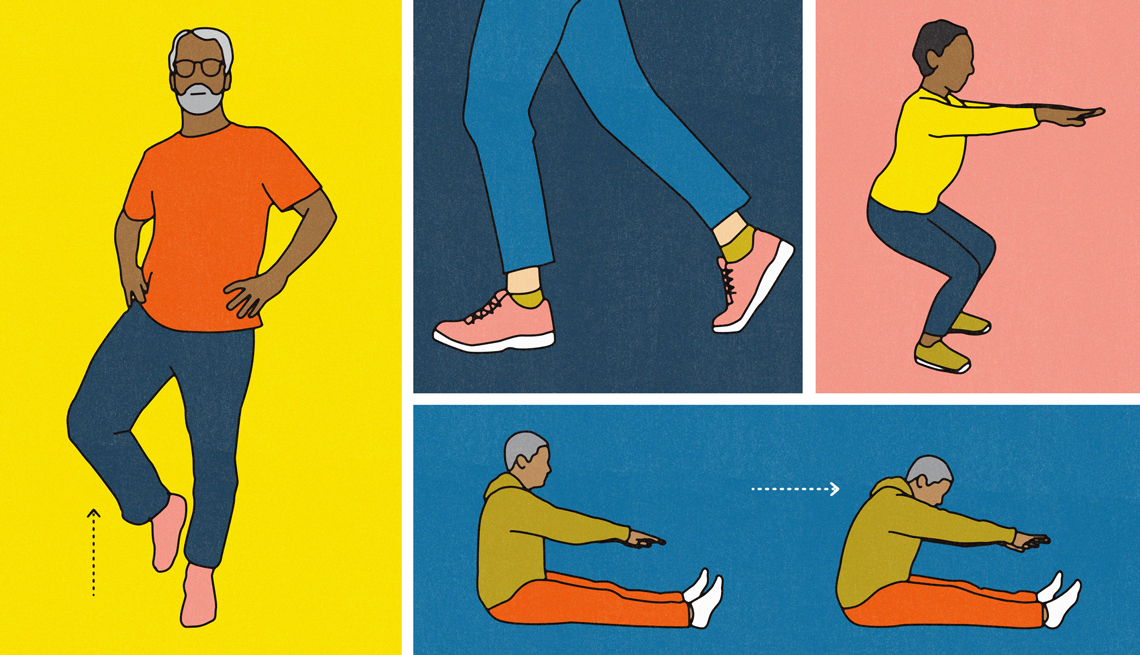
Although taking these tips will lend stability, doing light exercises that increase natural balance can offer the greatest benefits. "The ideal time for a person to begin an exercise program is before he or she has a fall," says Stelzer. "But it's never too late to reap the benefits. Exercisewalking, stretching, weight training, dancing, yoga, and tai chican improve mobility and balance even after a fall."
Even with the home secured and the right tools in hand, the fear of falling can persist. First, don't let the fear scare you. It's a rational response to the possibility of injury, but one that needn't run your life. You can increase your peace of mind by preparing for emergencies. For example, ask a doctor or physical therapist to demonstrate techniques for getting up after a fall. Using protective devices can also boost your confidence; wearing a plastic hip protector under clothing can reduce the risk of serious injuries from falls. You can order one for $50-$65 from Safehip (877-728-3447). Soft hip pads can also help, but they're much less protective.
Finally, sharing the problem with others can be extremely beneficial. In 1993, Boston University's Center for Enhancement of Late Life Function debuted a program called "A Matter of Balance." Participants met to discuss their fears and trade tips. When a woman confessed that she avoided the symphony due to her fear, a brainstorming session produced three pages of solutionssuch as always getting a ticket for an aisle seat. When a man revealed that he was too intimidated to talk to his doctor about his fear, his peers suggested that he write down his concerns. The program is spreading throughout the U.S. and Canada; to get more details, call 617-353-7375 or visit the program's website.
Meanwhile, I'm hoping that tai chi will keep me sure-footed. I'm also keeping a clutter-free floor and lifting weights to increase strength. And, oh yes, I'm at the YMCA twice a week, dutifully practicing White Crane Spreads Its Wings, waiting to experience Joyous Breath and Passing Clouds.
Catherine Gandel is a health writer and is working on a book about the fear of falling.
Now, check out our illustrated guide to tai-chi moves that can boost your balance.
|