Photo by Firooz Zahedi/JBG Photo
|
Goldie Luxe
By Nancy Griffin, March & April 2006
She’s smart, sexy—and at 60 she’s still got what it takes for box-office gold. Now, Laugh-In’s former giggly blond is socking it to Hollywood with a new challenge: make more movies for grownups
|
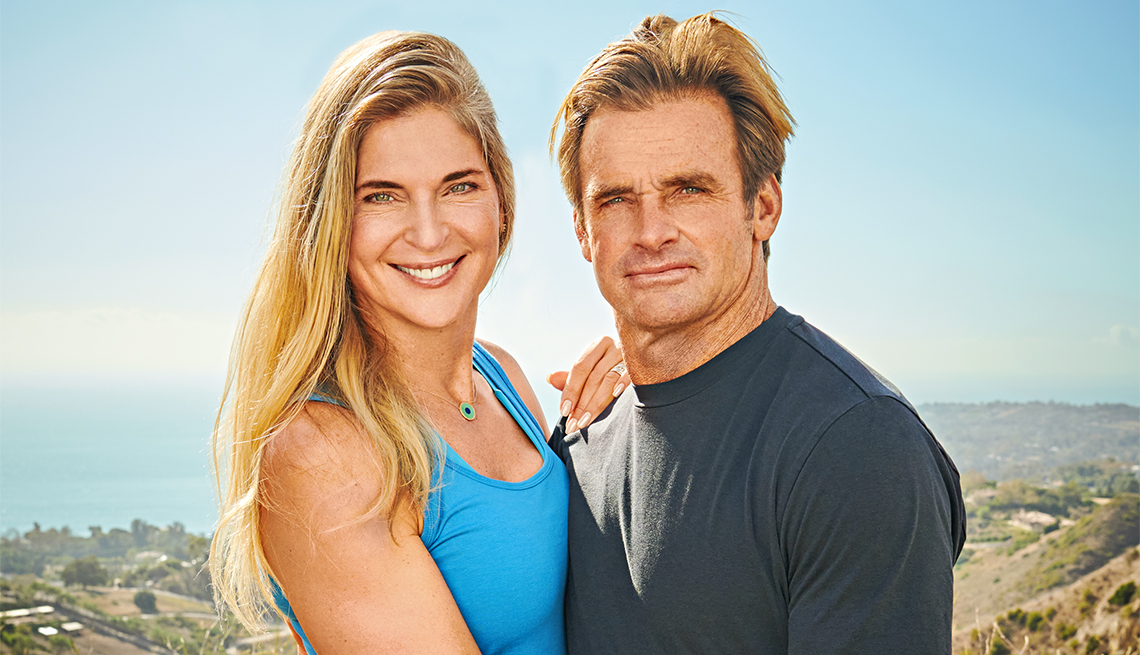
"I got a heart tattooed on my foot," says Goldie Hawn, laughing and
pulling her jeans up above one lizard-skin high heel to reveal a tiny blue
heart on her ankle. "It's my first tattoo."
Hawn and longtime love Kurt Russell, one of Hollywood's most enduring
movie-star couples (they met in 1984 while costarring in Swing Shift)
are ensconced in a tower suite at the Waldorf-Astoria Hotel in New York City,
in town on a brief business trip. Hawn is settled into a sofa talking about how
they celebrated her 60th birthday, while Russell quietly pads about in a
bathrobe. Now Russell, blowing his image as a macho dude, hikes up his pants to
show off a G on his leg. "She signed me," he says. "She drew it
on me, and the tattoo guy went over it."
For the record, Hawn's lithe dancer's body, big grin, and saucerlike
blue eyes are still intact, as are the shrewd business instincts that have made
her a powerhouse in Hollywood for decades. But the sexy-genarian grandma has a
more serious agenda to discuss today than tattoos: fed up with Hollywood's
obsession with youth, she is working to get more movies made with mature
characters and story lines that appeal to older audiences. As the aging
Hollywood star she played in the female revenge romp The First Wives
Club noted, she is tired of actresses' being relegated to three screen
roles: "babe, district attorney, and Driving Miss Daisy."
She is not, nor was she ever, the adorable nincompoop she played on Rowan
andMartin's Laugh-In, the television show that rocketed her to
stardom in the '60s. After winning an Oscar for her first film role in
Cactus Flower in 1969, she cemented her bankability with a series of
hits that included Private Benjamin, Foul Play, and
Shampoo. Although she demonstrated range with skillful dramatic
performances in such films as Spielberg's Sugarland Express,
audiences loved her best as the blond gamine who could always make them laugh.
She also succeeded at both producing (Protocol) and directing (the TV movie
Hope) but limited her professional commitments in order to raise her three
children: Oliver, 29, and Kate, 26, both from her second marriage and
established actors themselves, and fledgling hockey player Wyatt, 19, her son
with Russell. A cozy domesticity and family life have always been her first
priority. "All I ever wanted to be was happy," Hawn wrote in her
bestselling 2005 memoir, Goldie: A Lotus Grows in the Mud (Putnam), in
which she reveals herself as a lifetime spiritual seeker. (Readers of AARP
The Magazine can receive a 15 percent discount on her book by visiting
http://us.penguingroup.com
and entering coupon code GHLOTUS at checkout.)
AARP: Lifestyle Information for People 50 and Over
The entertaining and informative content on AARPmagazine.org is just one of the many benefits of AARP membership—only $12.50 a year. Join or renew online today!
Hawn believes that the huge success of The First Wives Club in 1996
proved that she and her costars (and buddies) Diane Keaton and Bette Midler
tapped into a market of older females hungry to see screen characters with whom
they could identify. But the studios won't green-light movies with
actresses over 40 in the leading role, with rare exceptions, such as
Keaton's Something's Gotta Give, a movie that got financed only
because Jack Nicholson joined the cast. The great screen actresses over 40 have
been all but sidelined. Even the mighty Meryl Streep, another pal of Hawn's
since they made Death Becomes Her together, has had to settle for plum
supporting roles, as in Prime and The Manchurian Candidate.
Undaunted by this harsh Hollywood reality, Hawn is now struggling to finance
a comedy called Ashes to Ashes, which she has written and wants to
direct and star in with Russell. Moviegoers in the 50-plus demographic, she
says, "need to stand up and say, 'We're not being served and
I'm mad as hell and I'm not taking it anymore.' Can you imagine if
that happened? Certainly Hollywood would sit up and go
'hmmmm.'"
Q: Where did you spend your 60th?
A: We were in Tahiti with my sons; Kurt took us all down there. Katie [daughter
Kate Hudson] couldn't come because she was working. And we just had a great
time. We had champagne and a great dinner on the beach, with candles and
pillows. It was just divine. It was Oliver who said, "I think in honor of
Mom's birthday we should all go get tattoos!" I thought it was a great
idea.
Q: Did 60 feel like a big milestone?
A: It did, actually, more so than 50. It's not how I look at the world;
it's how the world looks at me. That's really what you're dealing
with, because we're still the same inside. We still feel the same, we think
the same. The 60th was the birthday where everyone goes, "Wow, you still
look good, even though you're on your way to the end of your
days."
I feel incredibly frustrated knowing that there's an unserved audience that will come out for the right movie.
Q: How have you dealt with Hollywood's aversion to making movies
about older people, especially women?
A: Personally, I have never felt terribly frustrated by the system. I was doing
many other things, like raising my children. I didn't have much to complain
about: I was producing, creating, directing, acting, and doing really well. At
50 years old I was on the cover of Time magazine with First Wives
Club.
But now I have written a script called Ashes to Ashes that has
frustrated me more than anything I've ever done. It's a story about a
woman who is very successful and has traded success for some of the things that
she should have done to make herself happier as she grew older. She doesn't
have a good relationship with her son. She doesn't have a good relationship
with her ex-husband, and then he dies, and his spirit takes her to India to
teach her how to experience life again. The movie is big in scope. Kurt and I
are doing it together, and it may not get made because Hollywood fears it will
not have an audience.
Q: When you got into the business in the '60s and '70s, all the
studios were run by men. Now there are many women executives in Hollywood.
Doesn't that help in getting female-driven movies made?
A: Women have been absolutely no help, because they're working very hard to
please the men that they're working for, and they are afraid to stand up
for women. The movie industry has changed: we are now being run by
conglomerates and boardrooms. Hollywood is fearful because most of the films
that they put their heart and soul behind are heartless films that cost about
$180 million. So the industry has become about the big weekends, and it has
lost its passion to tell human stories. If they do them, they want them at a
very, very low budget. But when you look at women's films and the amount of
money that they have generated, it would shock you. There aren't many
women's films made, but the success rate of women's to men's films
is much greater. Nobody is looking at that.
Q: So why aren't the studios targeting older women?
A: Here's a good story. We did First Wives Club, and it netted
around $250 million. It was a great success, but they didn't want to do a
sequel. Diane [Keaton]—amazing, tenacious Diane—called me and said,
"We've got to do this. We've got to make this happen." So she
dug up a script that was rejected by them. I looked at it, and I thought that a
lot of it was quite funny.
So I got a call from the head of the studio, who said, "Let's try
to make it work. But I think we should all do it for the same amount of
money." Now, if there were three men that came back to do a sequel, they
would have paid them three times their salary at least. It would have been
demanded by their agents, and it would have been paid. Then it was reported to
me by my agent that the head of the studio said, "Isn't Goldie getting
a little greedy?" And she was a female, so in terms of women helping
women, this was really a kick in the butt.
Q: So you were once again relegated to the "difficult woman"
category?
A: Oh, yeah. But it hasn't stopped me from speaking out—speaking my
truth.
Q: How do studio executives react to Ashes to Ashes?
A: It went to different studios before Kurt got involved, and it was turned
down. The studio reaction always was, "Who's the man?" It's
just the way it goes. You can't win.
Now, I am not a complainer, and I never have been. I can't complain
about my life. I can't complain about the movies that I've done. But I
can feel incredibly frustrated at the state of the business and knowing that
there's an untapped, unserved audience out there that will come out for the
right movie.
Q: But while the studios are courting the young audience with hugely
expensive spectacles, the character-driven stories that appeal to older viewers
don't have to be so costly—they don't need explosions, car
chases, or special effects.
A: Right. You can spend $10 million or $15 million on films that are fun to
watch and have a little bit more of an adult theme. They don't have to be
slow and lugubrious; they can be interesting and challenging and motivating.
Movie businesses can be built on them. You don't have to make a gazillion
dollars. All I need for Ashes is $15 million. Everybody likes it; they are just
afraid. When I look at Cocoon, would that movie be made today? I'm not
sure. Or Driving Miss Daisy or Fried Green Tomatoes?
Q: In In Her Shoes, Cameron Diaz went against type by playing a
dark character. Do audiences prefer their blond comediennes to keep things
light?
A: They really do. You make them feel good, and they're not ready to trade
that in for anything. Right now Cameron is just this delectable, fabulous piece
of candy, and everybody wants a piece of it. Early on, I went through some real
soul-searching. I said, "Why am I not doing other kinds of roles? Why
can't I stretch and do that?" And I tried, but it didn't
work. It wasn't what they wanted to see. We are musical instruments: some
person might be a violin; the other one is a clarinet; another is a saxophone.
You can change your words, your hair, your makeup, but you can't change
that energetic essence that you are. And film knows that intimately, and it
does not lie.
Q: Do you want to say anything to the fans who have grown up with
you?
A: The only thing that I would say is, you've got to get your tushies out
of the seat and get to the movie theater. Everybody has to play their part.
It's a collaborative effort. You can't make a movie for nobody.
Don't miss film reviews, polls, message boards, and more on our Movies for Grownups™ Channel.
|